
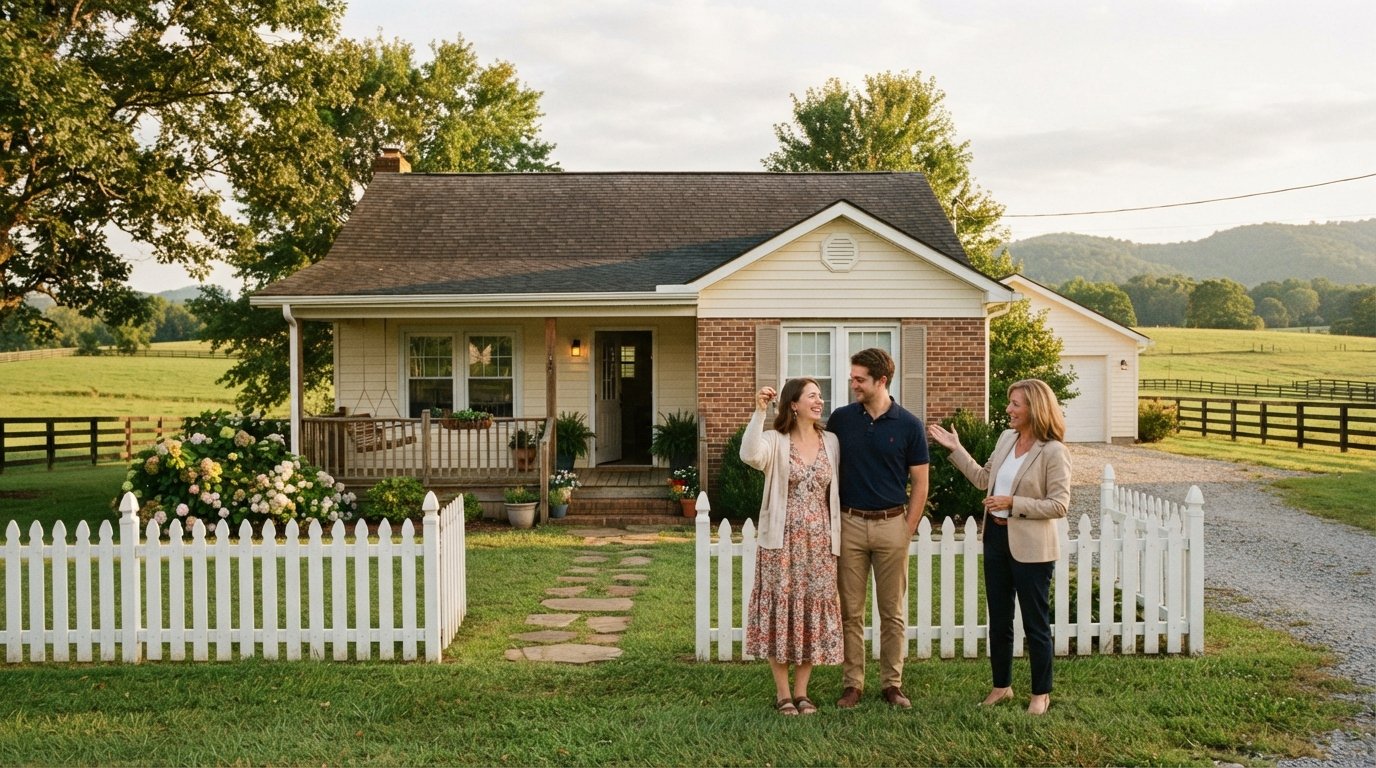
USDA Loan Program Rural Homeownership Explained
USDA loan program rural homeownership explained: see how zero-down financing and flexible credit rules make rural buying possible for moderate-income households.

By Wesley Miller
Buying a home in a small town or rural community often comes with a stubborn assumption: you need a large down payment and perfect credit to qualify. The USDA loan program challenges that assumption directly. Backed by the U.S. Department of Agriculture, this government-insured mortgage option was built specifically to make rural homeownership attainable for moderate-income households, and it remains one of the few mainstream loan programs that still allows 100 percent financing with no down payment required. For buyers who have been priced out of conventional loans or who simply want to keep more cash in reserve after closing, understanding how this program works can change the entire math of a home purchase.
What the USDA Loan Program Actually Is
The USDA loan program, formally known as the Section 502 Single Family Housing Guaranteed Loan Program, is a mortgage initiative administered by USDA Rural Development. It is not a loan issued by the government itself. Instead, the USDA guarantees a portion of the loan made by an approved private lender, which reduces the lender's risk and allows them to offer more flexible terms to borrowers. That guarantee structure is why lenders can approve zero-down financing, competitive interest rates, and lenient credit requirements that would be unusual in the conventional mortgage market.
The program exists for a clear policy reason: to support homeownership and economic stability in rural and small-town America. Congress created it to encourage families to put down roots in communities that might otherwise struggle to attract and retain residents. As a result, the eligibility rules are geographic and income-based rather than credit-score-driven. If you buy in an eligible rural area and your household income falls within program limits, you may qualify even with a modest credit history.
It helps to think of USDA loans alongside other government-backed options. In our broader guide to financing programs explained, we break down how FHA, VA, and USDA loans differ in down payment rules, credit thresholds, and property standards. The USDA stands out because it is the only one of the three that targets rural buyers specifically and the only one that routinely offers true zero-down purchase financing to non-veterans.
Who Qualifies for a USDA Loan
Qualification for a USDA loan rests on three pillars: the property location, your household income, and your overall credit and debt profile. Each pillar has its own rules, and failing any one of them can disqualify an otherwise strong application. Understanding these requirements before you start house hunting saves time and prevents the frustration of falling in love with a home that sits just outside an eligible zone.
The property must be located in an area the USDA designates as rural or rural-adjacent. These boundaries are not always intuitive. A suburb thirty miles from a major city might qualify, while a small town that has grown quickly might not. The USDA maintains an official eligibility map, and lenders can check a specific address for you. Population thresholds, currently set at 35,000 or fewer residents in most cases, determine whether a community appears on the eligible list.
Income limits are the second major gate. The USDA caps household income at 115 percent of the median income for the area, adjusted for family size. This is a total household figure, meaning all adults who will live in the home and earn income are counted, not just the borrowers on the loan. The limits vary widely by county, so a household that exceeds the cap in one part of a state might qualify comfortably in another.
Credit and debt requirements are more flexible than most buyers expect. While individual lenders set their own overlays, the USDA itself does not impose a hard minimum credit score. Many approved lenders work with scores in the 620 range, and some accept lower scores with compensating factors such as a strong rental history or low debt-to-income ratio. Here is a quick snapshot of the core eligibility factors:
- Property must sit within a USDA-designated eligible rural area
- Household income must fall at or below 115 percent of the area median income
- Applicants must be U.S. citizens, U.S. non-citizen nationals, or qualified aliens
- Borrowers must occupy the home as their primary residence
- Debt-to-income ratio typically should not exceed 41 percent, though exceptions exist
Notice what is missing from that list: no down payment requirement, no first-time buyer requirement, and no strict credit score floor. The USDA program is open to repeat buyers as well, which makes it unusual among low-down-payment options. A buyer who previously owned a home, sold it, and now wants to return to a rural community can use the program just as a first-time buyer would.
The Financial Benefits That Set USDA Loans Apart
The headline benefit is the zero-down structure. On a $250,000 home, a buyer using an FHA loan would need roughly $8,750 for the 3.5 percent minimum down payment, while a conventional loan buyer might need $7,500 or more at 3 percent down. A USDA borrower in the same scenario needs nothing down, which preserves savings for closing costs, moving expenses, and an emergency fund. That difference is often the deciding factor for households that can comfortably afford a monthly payment but have not yet accumulated a large lump sum.
Interest rates on USDA loans also tend to run below conventional rates because of the federal guarantee. Lenders take on less risk, so they price the loan more favorably. Over a 30-year term, even a quarter-point difference in rate translates into thousands of dollars in saved interest. The program does charge an upfront guarantee fee, currently 1 percent of the loan amount, which can be rolled into the loan balance rather than paid in cash. There is also an annual fee of 0.35 percent of the outstanding balance, similar in spirit to FHA mortgage insurance but generally lower.
Another advantage is flexibility in the credit decision. Because the USDA does not mandate a minimum score, lenders have room to consider the full picture. A borrower with a thin credit file, a recent credit event, or a nontraditional income history may still qualify if the rest of the application is strong. This is particularly valuable in rural areas where steady employment might come from seasonal work, farming, or a small family business rather than a conventional salaried job.
It is worth noting that the USDA also offers a direct loan program, separate from the guaranteed program described here. Direct loans are issued by the USDA itself and are reserved for very-low and low-income households, often with subsidized interest rates as low as 1 percent. The guaranteed program, which is the one most buyers encounter through lenders, uses standard market rates but with the guarantee-backed flexibility. Knowing which program you are applying for matters, because the eligibility rules and application process differ.
How the USDA Loan Process Works Step by Step
The path from first inquiry to closing on a USDA loan follows a predictable sequence, though it includes a few steps that conventional buyers never encounter. Planning for those extra steps prevents surprises and keeps your timeline realistic. Most USDA loans close in 30 to 45 days, similar to other government-backed mortgages, provided the property and income documentation are in order.
The process begins well before you make an offer. Before you shop, the right move is to check whether the homes you are considering are in eligible areas and to understand your income ceiling. Once you know your target zone, you can get pre-qualified with a USDA-approved lender. This step gives you a realistic price range and signals to sellers that you are a serious buyer. Pre-qualification is not a guarantee, but it is the foundation for a smooth transaction.
After your offer is accepted, the lender submits your file to the USDA for a conditional commitment. This is a formal review where the agency confirms that the property is eligible, your income qualifies, and the loan meets program standards. The USDA's review can take one to two weeks, and it happens alongside the lender's own underwriting. Once the conditional commitment is issued, the lender can clear any remaining conditions and schedule closing.
The property itself must meet minimum standards. USDA loans require a home that is safe, sound, and sanitary, which means the appraisal will look at the roof, foundation, plumbing, electrical systems, and pest issues. Unlike some conventional appraisals that focus mainly on value, the USDA appraisal includes a health and safety inspection component. Sellers sometimes need to make repairs before closing, and buyers should build that possibility into their negotiation strategy.
Here is the sequence in practical order:
- Confirm the property address is in a USDA-eligible rural area
- Verify your household income is within the county limit for your family size
- Get pre-qualified with a USDA-approved lender and gather income documentation
- Make an offer, then let the lender submit your file for USDA conditional commitment
- Complete the USDA appraisal and any required repairs, then close on the loan
Each step depends on the one before it, so delays in documentation or repair negotiations ripple through the timeline. Buyers who collect pay stubs, tax returns, and bank statements early tend to move through underwriting faster. Sellers who understand the appraisal requirements upfront are less likely to be caught off guard by repair requests.
Comparing USDA Loans to Other Low-Down-Payment Options
USDA loans are not the only path to homeownership with little money down, but they occupy a distinct niche. FHA loans require 3.5 percent down and allow lower credit scores, but they come with higher mortgage insurance costs and property limits that vary by county. VA loans offer zero down and no monthly mortgage insurance, but they are reserved for veterans, active-duty service members, and certain surviving spouses. Conventional 97 loans require 3 percent down and strong credit, and they phase out mortgage insurance once you reach 20 percent equity.
The USDA program sits between these options in several ways. It offers the zero-down benefit of a VA loan but is available to a much broader population. It has more flexible credit standards than conventional loans but generally requires better credit than the lowest-threshold FHA scenarios. Its guarantee fee structure is typically cheaper than FHA mortgage insurance over the life of the loan, which makes it more affordable for long-term borrowers. The trade-off is geographic restriction: you must buy in a rural area, and that requirement alone rules out many buyers.
For buyers who do qualify, the combination of no down payment, below-market rates, and lower insurance costs often produces the lowest monthly payment of any available option. That is why the program remains popular despite its geographic limits. It is also why rural real estate agents and lenders keep the USDA eligibility map close at hand.
If you are exploring rates across multiple loan types, comparing real-time quotes helps you see how USDA pricing stacks up against conventional and FHA offers. RateChecker provides mortgage rate comparisons and financial tools that let you run side-by-side scenarios before you commit to a lender. Seeing the actual numbers, rather than estimates, makes the decision clearer.
Common Misconceptions and Pitfalls to Avoid
One widespread myth is that USDA loans are only for farms. They are not. The program finances standard single-family homes, townhouses, and even some condos in eligible areas. You do not need acreage, livestock, or any agricultural activity. The name reflects the administering agency, not the property type. Many USDA borrowers buy ordinary suburban-style homes in small towns.
Another misconception is that USDA loans take forever to close. In reality, timelines are comparable to FHA and conventional loans when the file is complete. Delays usually trace back to incomplete income documentation or properties that fail the appraisal inspection. Buyers who submit clean paperwork and choose homes in good repair rarely experience unusual delays.
A more practical pitfall is overlooking the income calculation rules. Because the USDA counts total household income, a buyer might qualify on their own salary but fail once a partner's income is included. Conversely, a household might assume it earns too much and never apply, when in fact the county limit is higher than expected. Always verify the specific limit for your area and family size before ruling yourself out.
Finally, some buyers assume the zero-down feature means no cash is needed at all. Closing costs still apply, typically 2 to 3 percent of the purchase price. These can sometimes be covered by seller concessions or rolled into the loan through a lender credit, but they do not disappear. Budgeting for closing costs, moving expenses, and an emergency reserve remains essential even when the down payment is zero.
Is a USDA Loan Right for You?
The USDA loan program is a strong fit for buyers who meet three conditions: they want to live in a rural or small-town area, their household income falls within program limits, and they prefer to keep their savings rather than drain them for a down payment. For those buyers, it is often the most affordable mortgage available. The combination of zero down, competitive rates, and lower insurance costs produces monthly payments that conventional and FHA loans struggle to match.
It is less suitable for buyers who need to live near a major city, who have income well above the area median, or who want to purchase an investment property rather than a primary residence. Those buyers should look at FHA, conventional, or VA options instead. The USDA program is targeted by design, and its restrictions are the reason its benefits are so generous within its target zone.
Before you start shopping, confirm your eligibility, gather your documentation, and compare rates from multiple USDA-approved lenders. The program rewards preparation. Buyers who understand the income rules, the property standards, and the timeline tend to close smoothly and end up with a payment that leaves room in their budget for everything else that comes with owning a home.